
Luce County Civil Docket Searches
MiCOURT Case Search is the main online entry point. It serves a Luce County civil docket search. Have the full case number ready. No number? Search by party name, then narrow the results by court, category, year, and status. Captions can name an individual, an agency, a business, or an insurer. So a name match still needs a court and case-number check before you trust it.
Remember that MiCOURT shows public case information, not the official file. Check the court and the filing date. Check the case status and the event list too. A missing result is not proof that no Luce County case exists. It can simply mean the record type kept the case out. Online availability, confidentiality rules, or an older file could also be the reason.
- Identify the Luce County court from the amount, case type, and year.
- Search the case number first, keeping its hyphens and suffix.
- Use party names only when a number is unavailable.
- Read the Luce County ROA in date order.
- Ask the custodian for a particular filing, judgment, or certified copy.
Luce County District Civil Scope
The 92nd District Court holds exclusive civil jurisdiction up to $25,000. Its Luce County civil docket covers small claims, garnishments, summary proceedings, and land-contract forfeitures. Other matters are ones the county describes. Keep civil infractions separate. They are a distinct category, not a conventional damages case.
Michigan also runs a specialized small-claims track. It carries a $6,500 ceiling, though that figure is subject to current law and rule changes. Knowing the split helps a Luce County searcher. The split points to the right civil category and the right court. Not every money-related record travels the same docket path.
Note: A Luce County garnishment entry documents a collection process. It is not a finding about every issue in the underlying case.
Civil Dockets: What They Show
A Luce County register of actions can list the case number, court, caption, and parties. It may also show the filing date, case type, judge, pleadings, service entries, motions, orders, and judgment events. Costs and garnishment entries may appear too. So may satisfaction, discovery, and mediation entries. Read each Luce County entry by its event date and description. The short status label alone will not tell you enough.
| Case identity | Court, case number, caption, party names, filing date, and case type identify the Luce County file. |
|---|---|
| Pleadings | Complaint, answer, counterclaim, and amended filings state positions; they are not judicial decisions. |
| Service | Summons, proof of service, waiver, and appearance show steps in notice and participation. |
| Events | Pretrial, motion, mediation, settlement conference, or trial entries show activity and scheduling. |
| Outcome | Judgment, dismissal, summary disposition, settlement record if public, and satisfaction must be read in context. |
A closed civil case could reflect a judgment, a dismissal, a settlement-related entry, or a satisfaction record. The word "closed" alone does not say which. For the exact Luce County outcome, find the final entry and any related order.
Luce County Civil Events and Orders
Michigan civil-register samples show pretrial hearing, removed next event, rescheduled event, motion hearing, under-advisement entry, scheduling order, initial disclosures, settlement conference, and jury-trial activity. A Luce County ROA can use the same kinds of chronological events. A future motion hearing is a setting, while the later order records whether the court ruled.
MCR 1.109 supplies the Michigan rules on court records, captions, filing, and redaction. It supports a careful Luce County reading: use filed date, event description, and order date as separate fields. Do not call an event an order until the ROA records the order.
Review the official civil-record rule material that supports this distinction.
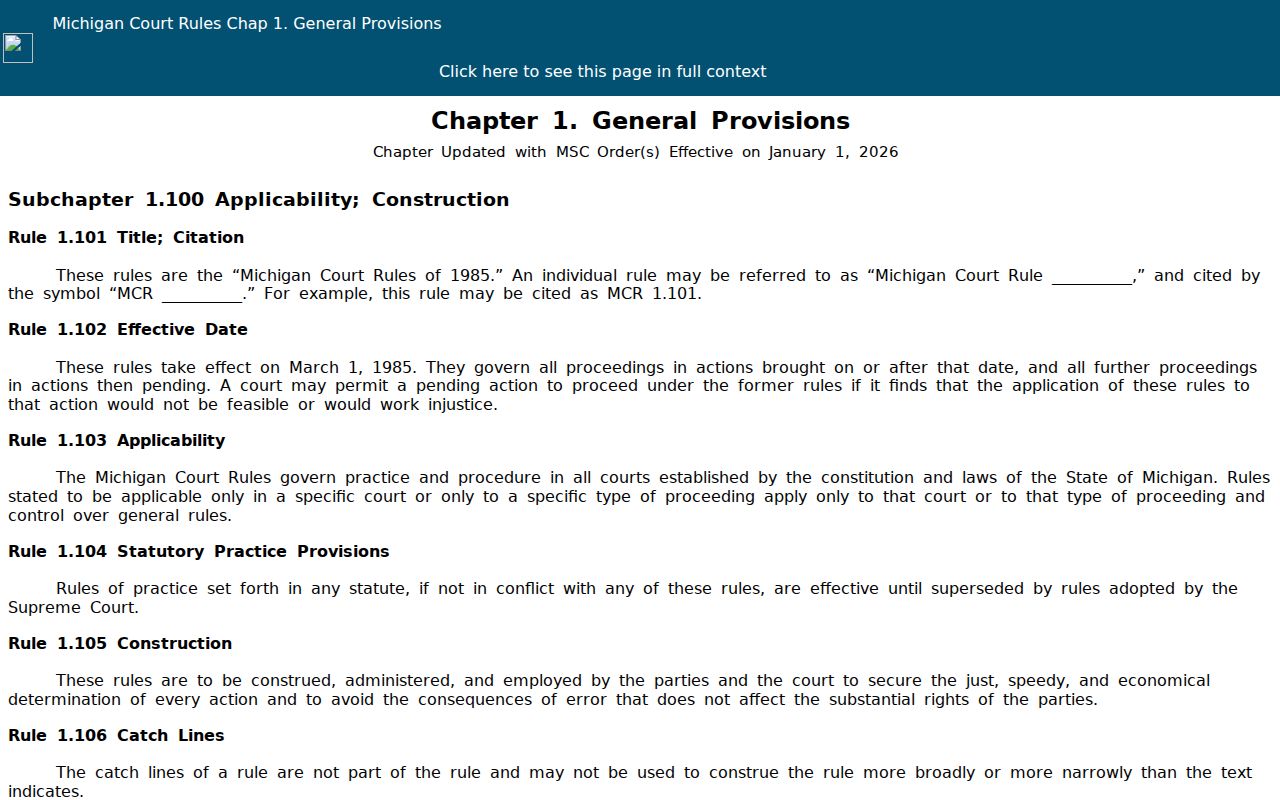
Keeping those fields apart helps a Luce County reader follow a docket with confidence. A scheduled item never counts as a ruling on its own.
What Cases Fill the Civil Docket
Luce County district civil dockets can include small claims, garnishments, and summary proceedings. Land-contract forfeiture matters appear as well. Other civil cases within district jurisdiction appear too. Always read the case-type field together with the court name. A small-claims case runs on a specialized process of its own. A garnishment, by contrast, is a process record tied to a judgment or collection effort.
- Small claims and other limited civil cases in the 92nd District Court.
- Garnishment records and related milestones.
- Summary proceedings and land-contract forfeiture matters.
- General civil claims at or below the Luce County district limit.
- Circuit civil matters that exceed district jurisdiction or are otherwise assigned by Michigan law.
When you make a request, identify the Luce County matter as district civil, circuit civil, small claims, garnishment, or a specific filing. That gives the clerk a usable description of the record. It also avoids a vague ask for a general background file that no office can fill.
Luce County Circuit Civil Records
The 11th Circuit Court handles Luce County general-jurisdiction civil claims above district jurisdiction. It also handles work Michigan law assigns to it. The circuit is shared with Alger, Mackinac, and Schoolcraft Counties. That sharing matters for searchers. Confirm the filing court and location before relying on any Luce County result.
| Luce County civil path | Typical jurisdiction | Record route |
|---|---|---|
| 92nd District Court | Civil claims up to $25,000, small claims, garnishments, and related limited work | MiCOURT and district clerk |
| 11th Circuit Court | General-jurisdiction claims above district limits and assigned civil matters | MiCOURT where available and circuit administration |
The circuit administrator's published Luce County contact is 906-293-5522 and aoven@lucecountymi.gov. The official circuit page links MiFILE and payment services. Payments being offered there does not mean a civil docket is publicly searchable from the same page.
Hearings on the Civil Docket
A Luce County civil setting can take many forms. It might be a pretrial, a motion hearing, mediation, a settlement conference, or a trial. Another scheduled event is possible too. Read the event type, the date, and any later removed, continued, or rescheduled entry together. The next event is not automatically the final hearing. A motion setting is still not the resulting order.
Use CourtDisplay for a published, date-oriented schedule. Then cross-check the case number in MiCOURT for public case information. The court posts no official Luce County daily civil-docket spreadsheet or PDF. If a hearing seems missing or recently changed, confirm with the court the same day. For date-routing detail, see the Luce County court schedule.
Luce County MiFILE and MiCOURT Access
MiCOURT and MiFILE play separate roles in a Luce County civil case. MiCOURT handles public case searches. MiFILE is Michigan's e-filing system, so it serves lawyers and parties who file documents. Having e-filing access is not the same as a full viewing right. It does not reach every court record page. Check the official available-courts list to learn which Luce County courts currently participate.
Searching is simple when you bring the right details. Use the case number or a narrow party query. For filing questions, confirm the Luce County court's current MiFILE procedure. For a copy of a court file, speak with the clerk who keeps it. A public case caption does not open restricted pages. An electronic filing route does not open them either.
Who Can See Civil Dockets
MCR 8.119 sets the Michigan framework for access to court records. It covers inspection, copies, redaction, and nonpublic records. Many Luce County civil ROAs are public. Still, a protective order or statutory rule can close off a particular filing. A nonpublic designation can also close off a field. A public search does not display every document or sensitive item.
Access point for Luce County civil files.
MCR 8.119 covers the public register, access, copying, and redaction framework.
MCR 1.109 governs captions, electronic records, filing, and personal-information treatment.
County FOIA may seek Luce County administrative records, but it does not override court-file restrictions.
Ask the court directly about any document you want. It can tell you whether the item is public, redacted, sealed, or protected. It can also explain the request method. The county FOIA route still fits administrative material held by the county. It is not a workaround for a restricted court file.
Luce County Civil Clerk Fallback
When a Luce County civil record is not available online, go straight to the court that kept it. The district clerk's published number is 906-293-5531. Circuit administration is 906-293-5522. In-person requests go to 407 W. Harrie Street, Newberry. Mail and fax can work too. But the county does not publish one universal civil-record form or fax destination, so confirm before sending sensitive material. The official circuit contact page shows the current civil-access details.
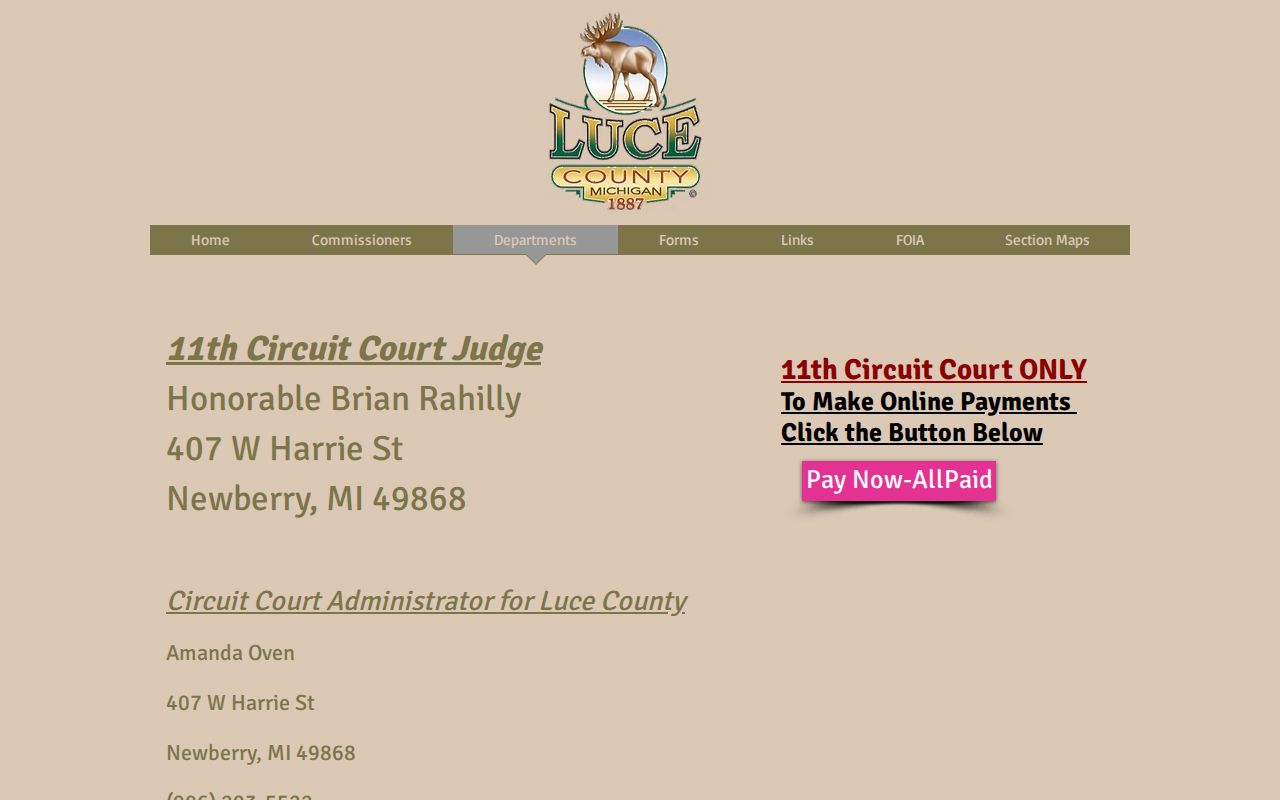
The two contacts reflect Luce County's separate district and circuit civil record paths. Ask for the complete ROA by name. The same goes for a filing, a plain copy, or a certified judgment.
Before requesting a copy, identify the right Luce court and the right Luce civil path. A request to the Luce 92nd District may involve small claims. Garnishment or a limited civil record also fits. A request to the Luce 11th Circuit may involve a general-jurisdiction civil file. The district clerk and circuit administration keep different record routes. Both work out of the Luce County Courthouse.
Give the clerk the case number, caption, filing year, and the document you need. The clerk can then tell you whether the item is public, redacted, or archived. Copy options come plain or certified. That location check prevents one mix-up. It keeps a shared-circuit result from being mistaken for a Luce filing.